Showing posts with label paprika. Show all posts

Thursday, August 19, 2010

rocking the casbah

Deborah
Eggplant has never made me tremble with joy when it comes to flavor. I generally think of it as a vehicle for garlic and olive oil. Eggplant Parmesan is the rare treat when I am not watching calories and want a blast of rich gooey pleasure. It was not until I encountered a recipe for Moroccan Eggplant Salad that I understood the satisfaction of a delicious eggplant dish. The inspiration comes from a wonderful cookbook called Taste of Morocco by Richard Carrier.
Carrier's book is a lovingly crafted tribute to Moroccan cooking traditions and techniques. If you ever come across a copy of this out-of-print book from 1987, grab it. The stunning photos and simple recipes will make you fall in love with Moroccan cuisine. (Here is an excerpt from the book)

Carriers book has many great recipes for cooked vegetable salads, which were a revelation for me when I first started to cook them.
Eggplants may not have the most interesting flavor, but they sure look pretty in pictures. The pleasing curvy shape is a favorite among still life painters.

To start the dish peel and slice the eggplant, leaving some of the skin on. Many recipes instruct you to salt the slices and let drain for a half hour, rinse, then pat dry before frying. There is debate about the value of this step (to rid the fruit of bitter flavor). I don't know. I do it if I have time.
While the eggplant is frying make a paste of four garlic cloves, 2 Tbs. paprika, 1/2 teas. cayenne, 1 teas. cumin and some lemon peel. It can be coarsley chopped or ground into a paste with a mortar and pestle.
Use enough olive oil to cover the bottom of your pan for frying. Let the slices become golden on both sides and then set aside, cooking the eggplant in batches.
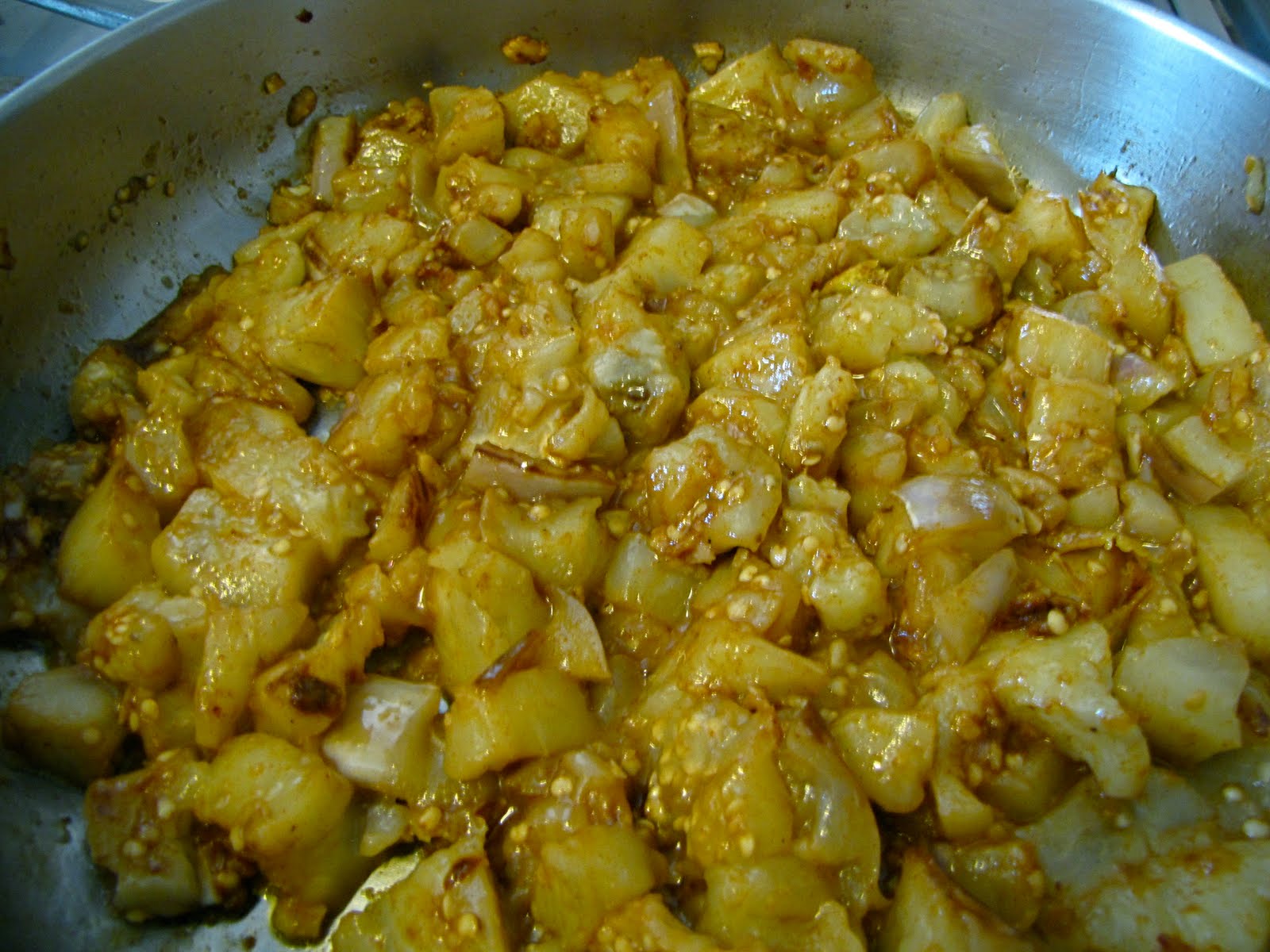
When all the slices are fried, roughly chop the cooked slices and return the eggplant to the pan. Add more oil if you need to, but wait to see if you really need it. Eggplants can absorb a lot of oil when cooking and then release it when almost done. Add the garlic spice paste to the pan and continue to cook for about 15 minutes stirring and breaking down the chunks of eggplant with a wooden spatula. Let the eggplant mixture cook until it gets a nice deep golden brown. Taste for seasoning.
Finish the salad with lots of chopped parsley and the juice from 1/2 a lemon.
Let the salad come to room temp before serving. The eggplant will be creamy with a deep rich flavor from the spices. This can be made a day in advance and stored in the fridge. Serve this salad outdoors as part of a picnic and it will feel like a trip to the oasis!

Amanda
Wow! That looks wonderful. I would love to try that on a slice of terrific, crusty bread. And I love that the dish is so simple. Now, this is a dish that I would pay attention to the spicy flavors when choosing a wine to go with it. The cayenne pepper will give heat - so be sure not to pick a wine too high in alcohol content. The high alcohol content in wines will exacerbate the heat of the pepper. A wine with a touch of sweetness, however, will be a great contrast to the heat and will complement it well. A German Riesling would make a tantalizing match to this beautiful dish. Seek out a "Kabinett" which tend to be off-dry, and light with crisp acidity.

For those of you unfamiliar with the German system of classifying wines, it can be extremely daunting. People tend to veer over to the German wine section, take a look, and coyly turn away. Don't let the enigma of the label deter you from experimenting - the wines are worth it. And once you understand their system better, you will be able to decipher any label.


Why people tend to avoid German wines. They are confused about what they're buying!

In a nutshell, Pradikatswein is the top level of the classification system. Most of the wines in this category are of high-quality. Within this level, wines can range from dry to very sweet, depending on the grapes level of ripeness, with Kabinett being the first designation. The sugar content of the grape juice helps determine into which designation the wine will fall. Spatlese is the next level up, and is typically fruitier and sweeter than the Kabinett. From there, the wines increase in sweetness into the categories Auslese, Beerenauslese, Eiswein, (yummy); and Trockenbeerenauslese, with each rung on the ladder being sweeter, with higher sugar content, then the last. For Deb's recipe, I would stick with either a Kabinett or a Spatlese. (Also, German wines are typically lower in alcohol content).


Today, many German producers are making their labels much simpler and user-friendly.

For wonderful Rieslings, look for the wines of Joh Jos Prum. The wines are simply marvelous. Weingut St. Urbans-Hof is another of my favorite German producers. Spectacular wines at affordable prices. The Ockfener Bockstein Riesling Kabinett is a terrific representation of the wines from the Mosel Saar Ruwer region (and would be exquisite next to Deb's dish). This particular wine can be found in the $15 price range.

If you are looking to enjoy a red with this dish, my first choice would be a fruity, new-world Pinot Noir. (New world meaning American, Australian, e.g. as opposed to old world like French). Again, avoid wines with lots of alcohol like Australian reds or big Cabernet Sauvignons.

Wednesday, January 20, 2010

something different

Deborah
This week's episode of No Reservations got me hankering for something exotic. Anthony Bourdain was wandering all over Istanbul eating everything in sight. The one dish that really caught my eye was part of a home-cooked meal; baked artichoke hearts with peas and fava bean puree. Wow.
As I generally do after watching one of his shows, I wandered over to my cookbooks and scanned around for further inspiration. This time I  immediately gravitated towards Paula Wolfert, someone I consider a high priestess of Meditteranian cookbook writers. Her meticulous research and devotion to authenticity always provides interesting reading. The two books of hers that I own (Mediterranean Cooking and The Slow Mediterranean Kitchen) did not have the recipe I was looking for, but I got distracted by her Turkish Red Lentil Soup.

Dried Red lentils are so pretty AND they are easy to cook. Too bad they lose their pert orange color; when cooked and tender they turn a pale yellow.

The soup recipe sounded easy to make so I gave it a try. The procedure was basically just cooking onions, garlic, red lentils and rice in water till softened. The unusal part of the recipe is that as a finishing touch Wolfert has you create a roux from butter and flour, cooking until it is "hazelnut brown" in color and then adding stock to it before adding this to the soup. This was an unfamiliar technique for me as far as soups go, so I was excited to try it. Leave plenty of time to cook the roux, if you try this. I cooked mine on the lowest heat for about 45 minutes, which was as long as it took for the lentils to cook.
The other intriguing finish was a SIZZLE created by melting butter and then briefly sauting paprika and dried mint and then stirring that into the soup as a garnish.

tada!

Well, the soup came out great, very smooth and creamy, almost too smooth, I think.  I would probably only puree half the ingredients next time and leave some texture. The flavor was surprisingly exotic and unfamiliar considering the simple ingredients. I really felt like I was tasting something different. What a nice treat, and I did not have to leave home!

Turkish Red Lentil Soup
adapted from Paula Wolfert's The Slow Mediterranean Kitchen
For the Soup:
1Tb butter
1/3 cup grated onion (one small onion)
1 clove of garlic, mashed
1 cup red lentils, rinsed and drained
2 Tbs white rice
1/2 cup chopped tomatoes
1 1/2 quarts water

For the Roux:
2 Tbs butter
2 Tbs flour
2 cups vegetable stock

For the SIZZLE:
1 Tbs. butter
2 tsp paprika
1 tsp dried mint, pressed through a sieve to make a powder

To make the soup- In a large soup pot, saute the onion and garlic in the butter for 5 minutes, till golden. Add the lentils, rice, tomatoes and water and bring to a boil. Cover pot and lower  flame to a simmer, cook for 45 minutes.

MEANWHILE- to make the roux- In a small sauce pan melt the butter, then add the flour and whisk to combine so there are no lumps. Slowly heat the mixture under a VERY low flame and stir from time to time. The roux will gradually take on a warm golden color. Wolfert says go for a hazelnut brown, which took me about 45 minutes to achieve. Slowly add in the stock, whisking to prevent lumps. Cook for 5 minutes.

Back to the soup- Transfer half the soup with a slotted spoon to a food processor or blender and the other half to a clean pot. Don't add all the liquid, you wont need it, remember you are going to be adding two more cups of the roux liquid into this. Blend the soup until it is very smooth and add it to the pot with the unblended half. Add the roux liquid to the soup pot and warm  everything together for 5 minutes on a low heat.

Make the SIZZLE: In a very small pot, melt the butter and add the paprika and the mint. Cook for 5 minutes and then drizzle the sizzle into the finished soup.

serves 4


Thursday, December 10, 2009

Brightening the Day

Deborah
One of the pleasures of the season is the emergence of all things citrus. This time of year I really look to citrus fruits to fill an important role in my winter cooking- they must bring the sweetness, the freshness and the brightness to the recipes. Peaches and tomatoes are out for now. Fresh herbs are fast disappearing from my garden as we finally have a real frost going. So it is the citrus family that will carry me through, gulp, till Spring. sigh.

Now I know citrus fruits are not local to me here in Queens, NY, but they were MEANT to travel. They have that nice thick skin, like a fancy suitcase, perfect for a long journey. I just got back from a weekend in Sarasota, Florida where it rained for two days. I went to the farmers market tucked into my rain slicker and the farmers were very happy to see me. Happy to see ANYONE actually, because in Florida the weather is supposed to be perfect and if it is even a little off, people just stay home, so they tell me. It was true that I did not have to wait on line at all at the popular organic produce vendors and I actually got to have some leisurely chats with those farmers. So let it rain, HA!


I bought half a dozen local tangerines that still had leaves attached (I LOVE THAT!!!). They weren't the prettiest color in the world but I have learned that the skin of citrus fruit is NO INDICATION of what is inside and in this case it held true again. The fruit was sweet and juicy and sooooooo fragrant. Where are the pictures you might ask.
Some cute tangerines sitting in this vintage Russel Wright dish I purchased at the flea market in Long Boat Key,  Florida at a bargain price, 50% off, for a grand total of $3.00!!

I am sorry to report that I FORGOT to bring my camera. Oh my. But it was raining so it really didn't matter. Anyway, I packed the tangerines that were left over from the weekend into my hand luggage and they travelled home with me. SO when is local local? The fruit was local when I bought it and I had to come home anyway. So it goes. I still exempt citrus fruit from the local thing. Like I said,those guys were MEANT to travel!

Amanda, does any wine work well with tangerines perchance? I made a salad with tangerines, onions, capers and goat cheese and dressed it with a tangerine, sherry vinegar and walnut oil vinaigrette adding a pinch of smoked paprika. A very nice way to brighten up a December table.


Tangerine, Capers & Goat Cheese Salad
1 Tangerine, peeled and cut into slices
1 teaspoon capers
2 oz crumbled goat cheese
1 TBs Thinly sliced Onion
2 cups washed mixed salad greens


Tangerine & Walnut Oil Vinaigrette
Juice of 1 Tangerine (my tangerine yielded 1 Tbs of juice, not much LOL!)
1/2 teaspoon smoked paprika
1 teas. salt
1 teas. freshly ground pepper
3 TBs Sherry Vinegar
1/4 cup walnut oil

For the salad- combine all the ingredients in a bowl
For the dressing- combine all ingredients in a small bowl except the walnut oil. Mix well with a whisk. Slowly drizzle in the walnut oil as you continue to whisk until well blended. Toss vinaigrette with the salad and serve.

serves two.

Amanda
I love the way this recipe sounds! Most often I think long and hard about what wine would be the perfect accompaniment to these dishes. For me, this one was a no-brainer. First, let me again emphasize that salads and wine pairing are tricky. Very few wines can pair well with a salad. This is due large in part to the vinegar in the dressing - it wreaks havoc on the palate. Second - this is definitely a fall salad, and my mind, and mouth, go immediately to white. I typically don't drink white very  much in the cooler weather. This is just a personal thing, not a rule! 


But right away I think of California Sauvignon Blanc. This varietal, when grown in a warm climate, shows off beautiful passionfruit and citrus flavors. I think these characteristics, along with the tangerine in the dressing and on the salad would be perfect. I particularly am impressed with the Provenance Sauvignon Blanc 2008 from Rutherford in the Napa Valley. A touch of Semillon is added with gives the wine roundness and a bit of richness too. While not a sweet wine, there are prominant sweet fruit flavors which I think would offer a nice counterpart and balance to the saltiness of the capers. The Provenance was rated 91 points by The Wine Spectator, and just appeared on their Top 100 Wines of 2009 List. At $14.99, this is a great buy!


MaryAnn Worobiec from The Wine Spectator had this to say about the 2008 Provenance Sauvignon Blanc: "Key lime, passion fruit, melon and nectarine flavors are ripe, juicy and fleshy, with great intensity, a vivid acidity and terrific focus and clarity. "


Deb - I will definitely be trying this combination! I anticipate another winner!