Showing posts with label Riesling. Show all posts

Wednesday, September 15, 2010

A walk on the wild side

Deborah
There seems to be no denying that summer is over. The change in the air is palpable. A walk through Jamaica Bay Wildlife Refuge this weekend brought the truth of the matter home. Leaves are curling up and changing color and that is the way it is.
If you are in the NY area and have an opportunity to visit and hike around the Jamaica Bay Wildlife Refuge it is well worth the visit. The view of the NYC skyline is dazzling!

This talk of the wildlife refuge has been my way of avoiding the inevitable, which is that as I was cooking the other day I came upon an amazing discovery that tasted so good I decided to improve upon it and share it with you. This evening I decided to take that recipe to the next level and as the phone rang at home and I caught up with friends and family and recovered from my first day at a new job (more about that in upcoming posts) I took a perfectly good recipe and made it into something very uninspiring and blachhhhhh! My point in all this is to say that even those of us very comfortable in the kitchen can go horribly awry and make something not so great. What can I say? I was distracted and somewhat stressed and inattentive. Cooking can be hard work and a zen-like calm is always to be strived for . My dish was edible but uninspired. I will share with you the original inspiration and explain where I went wrong.
Amanda has described our blog as catering to flexitarians, which I believe means for those who occasionally eat meat and fish. In that spirit I am including my fondness for this spicy fish condiment from the Korean supermarket H Mart in Queens. I add it to the wok to add depth and flavor. The fresh noodles shown here are thick and chewy. Very filling and satisfying.

The inspiration: I had some baby bok choy, sauteed some garlic in a wok, added the bok choy and then a big spoonful of spicy fish condiment from the koraen market. This simple preparation was so good I thought I would faint.

Next Day: Oh I am so clever I am going to make this even better: Sauteed leeks, cabbage, green beans, mustard greens- threw in the spicy fish condiment and some fresh noodles. Oh ugh. Just a big strange mess. Did not taste terrible but had no personality, nothing distinctive. oy. so sorry.

It looks colorful, but it was not at all what I was going for. In this instance mustard greens were not a good substitute for bok choy. These great ingredients tasted good none the less. Taking a risk in the kitchen can be a great learning experience.

Amanda, I could really appreciate a good glass of wine right now. Any suggestions?

Amanda
Deb, your experiment really yielded some interesting results. I guess this is a perfect example of "less is more". Your elaboration on the dish was really just the addition of some seemingly perfectly well-suited veggies. It's interesting to me that the dish had more personality without these extras. Definitely a great lesson, and one which I most certainly will heed!

Last night, after I left the gym, I was  really in the mood for something healthy and simple. I had bok choy on the brain after reading Deb's post. So, I made a quick stop at the store and picked some up, in addition to some shitakes. Now, I have never cooked with bok choy and I must admit I really didn't know what to do with it in terms of cleaning it up, etc. In Chinese restaurants, I've only seen the white part of the stalk used, so I wondered about the leaves. Ultimately, I prepared a light dish that was really quite tasty. I just chopped up the bok choy (white stalk and leaves. Deb - is this they way you use it?) I sliced the shitakes and threw them under the broiler for a few minutes. I heated some oil and garlic in a saute pan. Added the bok choy and sauteed till wilted. Tossed in a little soy sauce, a touch of mirin, and a generous squeeze of lemon juice. I added the broiled shitakes to the finished mix and it was surprisingly yummy! And painfully simple!

It was late, and having just had a successful workout at the gym, I opted to not have a glass of wine with my creation. But, it made me consider Deb's recipe and what might be a good choice. Her dish is "spicy", and I would imagine the fish condiment has a good amount of salt.  The heat of the dish combined with the saltiness leads me to pick a white wine with a little sweetness. As always with spicier dishes, avoid anything with high alcohol or lots of tannins. Wines with a touch of sweetness will quell the heat your tastebuds are experiencing. Sweeter wines will also work particularly well with salty foods. (don't go too sweet, though. Just a hint of sweetness will suffice) If you happen to love chocolate covered pretzels as I do, you'll understand this reasoning. The contrast when eating something sweet and salty at the same time is wonderful!

The other night, I enjoyed a bottle of Vouvray which would be perfect. Vouvray is a white wine from the Loire Valley in France and is made from Chenin Blanc. The Vigneau Chevreau Vouvray Cuvee Silex is considered dry, but my palate experienced a hint of sweetness. Just delicious, and perfectly suited to Deb's recipe. Ask your local retailer for a recommendation on a Vouvray. Another option is a German Riesling with the "Spatlese" designation. Spatlese wines are made from fully ripe grapes and is the lightest of the "late harvest wines". The grapes for Spatlese are riper than those used for "Kabinett" wines. Therefore, the wines have greater intensity than those that are designated "Kabinett". Spatlese wines typically have a touch of sweetness - they are not fully sweet. A good, basic level Spatlese to experiment with is the Peter Mertes Riesling Spatlese. An affordable choice, this particular wine can be found for around $10.

Thursday, August 19, 2010

rocking the casbah

Deborah
Eggplant has never made me tremble with joy when it comes to flavor. I generally think of it as a vehicle for garlic and olive oil. Eggplant Parmesan is the rare treat when I am not watching calories and want a blast of rich gooey pleasure. It was not until I encountered a recipe for Moroccan Eggplant Salad that I understood the satisfaction of a delicious eggplant dish. The inspiration comes from a wonderful cookbook called Taste of Morocco by Richard Carrier.
Carrier's book is a lovingly crafted tribute to Moroccan cooking traditions and techniques. If you ever come across a copy of this out-of-print book from 1987, grab it. The stunning photos and simple recipes will make you fall in love with Moroccan cuisine. (Here is an excerpt from the book)

Carriers book has many great recipes for cooked vegetable salads, which were a revelation for me when I first started to cook them.
Eggplants may not have the most interesting flavor, but they sure look pretty in pictures. The pleasing curvy shape is a favorite among still life painters.

To start the dish peel and slice the eggplant, leaving some of the skin on. Many recipes instruct you to salt the slices and let drain for a half hour, rinse, then pat dry before frying. There is debate about the value of this step (to rid the fruit of bitter flavor). I don't know. I do it if I have time.
While the eggplant is frying make a paste of four garlic cloves, 2 Tbs. paprika, 1/2 teas. cayenne, 1 teas. cumin and some lemon peel. It can be coarsley chopped or ground into a paste with a mortar and pestle.
Use enough olive oil to cover the bottom of your pan for frying. Let the slices become golden on both sides and then set aside, cooking the eggplant in batches.
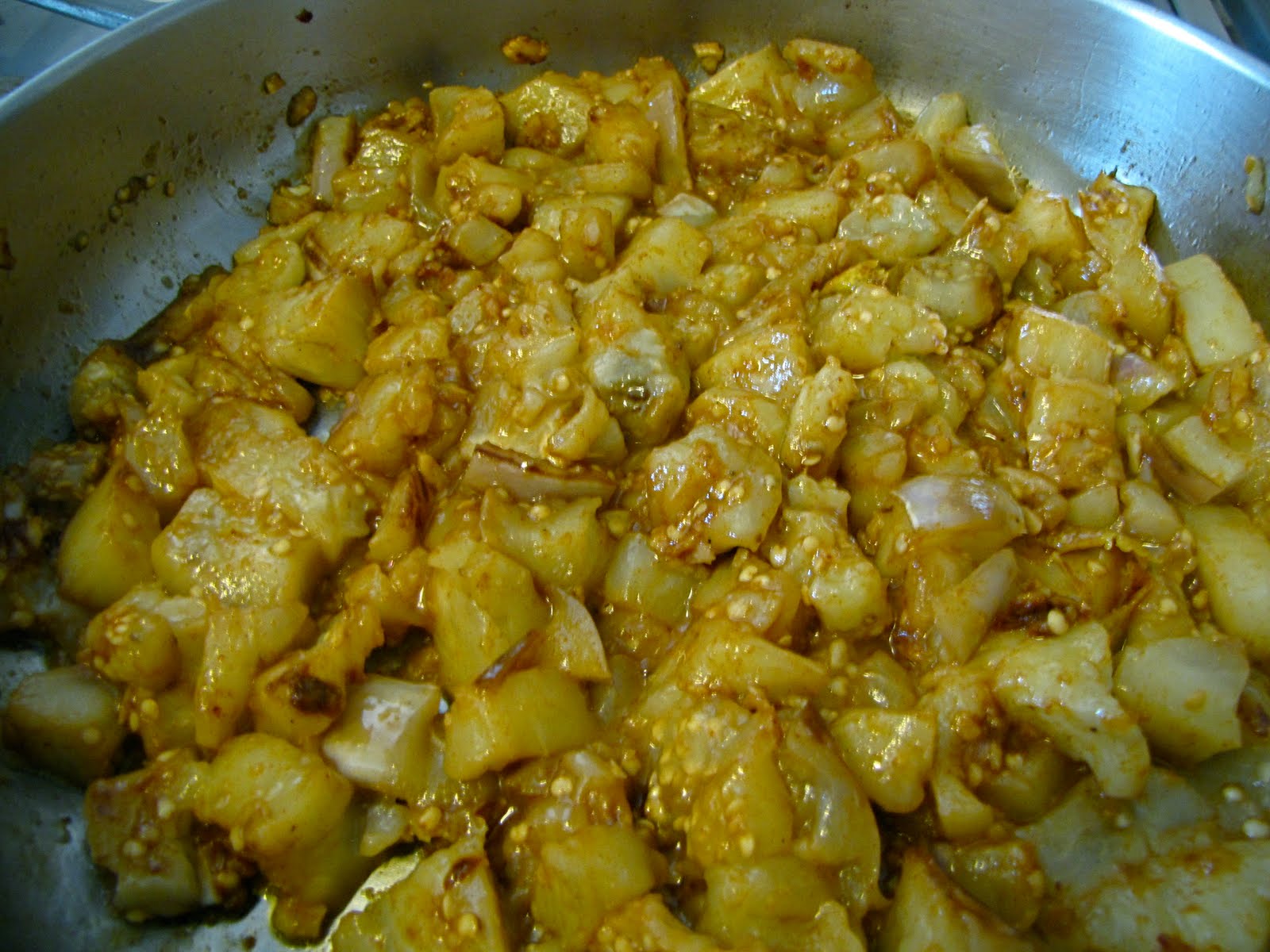
When all the slices are fried, roughly chop the cooked slices and return the eggplant to the pan. Add more oil if you need to, but wait to see if you really need it. Eggplants can absorb a lot of oil when cooking and then release it when almost done. Add the garlic spice paste to the pan and continue to cook for about 15 minutes stirring and breaking down the chunks of eggplant with a wooden spatula. Let the eggplant mixture cook until it gets a nice deep golden brown. Taste for seasoning.
Finish the salad with lots of chopped parsley and the juice from 1/2 a lemon.
Let the salad come to room temp before serving. The eggplant will be creamy with a deep rich flavor from the spices. This can be made a day in advance and stored in the fridge. Serve this salad outdoors as part of a picnic and it will feel like a trip to the oasis!

Amanda
Wow! That looks wonderful. I would love to try that on a slice of terrific, crusty bread. And I love that the dish is so simple. Now, this is a dish that I would pay attention to the spicy flavors when choosing a wine to go with it. The cayenne pepper will give heat - so be sure not to pick a wine too high in alcohol content. The high alcohol content in wines will exacerbate the heat of the pepper. A wine with a touch of sweetness, however, will be a great contrast to the heat and will complement it well. A German Riesling would make a tantalizing match to this beautiful dish. Seek out a "Kabinett" which tend to be off-dry, and light with crisp acidity.

For those of you unfamiliar with the German system of classifying wines, it can be extremely daunting. People tend to veer over to the German wine section, take a look, and coyly turn away. Don't let the enigma of the label deter you from experimenting - the wines are worth it. And once you understand their system better, you will be able to decipher any label.


Why people tend to avoid German wines. They are confused about what they're buying!

In a nutshell, Pradikatswein is the top level of the classification system. Most of the wines in this category are of high-quality. Within this level, wines can range from dry to very sweet, depending on the grapes level of ripeness, with Kabinett being the first designation. The sugar content of the grape juice helps determine into which designation the wine will fall. Spatlese is the next level up, and is typically fruitier and sweeter than the Kabinett. From there, the wines increase in sweetness into the categories Auslese, Beerenauslese, Eiswein, (yummy); and Trockenbeerenauslese, with each rung on the ladder being sweeter, with higher sugar content, then the last. For Deb's recipe, I would stick with either a Kabinett or a Spatlese. (Also, German wines are typically lower in alcohol content).


Today, many German producers are making their labels much simpler and user-friendly.

For wonderful Rieslings, look for the wines of Joh Jos Prum. The wines are simply marvelous. Weingut St. Urbans-Hof is another of my favorite German producers. Spectacular wines at affordable prices. The Ockfener Bockstein Riesling Kabinett is a terrific representation of the wines from the Mosel Saar Ruwer region (and would be exquisite next to Deb's dish). This particular wine can be found in the $15 price range.

If you are looking to enjoy a red with this dish, my first choice would be a fruity, new-world Pinot Noir. (New world meaning American, Australian, e.g. as opposed to old world like French). Again, avoid wines with lots of alcohol like Australian reds or big Cabernet Sauvignons.

Monday, May 17, 2010

what's in a name?

Deborah
To continue with our grilling theme I offer you my version of grilled vegetables with a fresh herb &  black olive pesto tapenade vinaigrette. A what? I know the name is a bit in-elegant. I generally resist fancy, overwrought names for dishes and prefer to call things as they are.  This one has me stumped because it is all and none of the sum of it's parts. That is to say, it is not strictly a pesto, nor tapenade, nor vinaigrette- but more of a bastardized version of the attributes of all three. OK, I'll shut up.

Beautiful colors!- These vegetables are cut into slabs or wedges so they will cook quickly and evenly.


The cut vegetables are arranged on the hot part of the grill with just a brush of olive oil at this point.


A grill basket would come in really handy now. The risk-all approach means there inevitably will be a few veggie casualties.
I tossed a little scotch bonnet pepper on the grill and when it got to my plate and I took a bite- YEAOCH!! that baby was very hot :-)
The cooked vegetables get put into a pan to keep warm. I toss the vegetables with a few spoonfuls of "the sauce" and serve the rest on the side.


fresh herb &  black olive pesto tapenade vinaigrette

1/2 cup pitted black olives (not canned!)
1/2 cup fresh leafy herbs- a single herb or any combination of the following: parsley, mint, basil, cilantro
1/4 cup olive oil
1 teaspoon salt
1 clove garlic
3 Tbs. red wine vinegar
2 Tbs. pine nuts

Put all ingredients in food processor and blend till combined. 
makes about 1 cup. Store in a jar in the fridge and use on everything (grilled veg and meats, on bread, pasta, cheese!)

Amanda
Wow! What a versatile recipe! There are so many ways I'd love to use this pesto-tapenade-vinaigrette. Wine pairing is tough, however, with a sauce/dressing like this as a result of the vinegar's high acidity. Stay away from soft, rich wines since the acidity will render them "flat" and blah. Definitely stick with something more lively and bright. I am thinking this recipe is on the salty side with the black olives and added tsp of salt. Therefore, why not sip something with a touch (just a touch) of sweetness to act as a counterpart to the dressing's saltiness? We all love that sweet/salty combination, right? Think chocolate covered pretzels. In addition to the "sweet" or slightly off-dry characteristic, I would choose something with good acidity.

Riesling would be my first choice. Nothing too sweet though. The other day we tasted a Riesling specifically made to complement all types of food. The creators' goal was to produce a wine to go with anything - hence the name Anything Goes Riesling. Well-priced at $9.99, I was impressed with this fun, everyday white. It is crisp, bright and lively - a perfect match for this "zippy" vinaigrette. The wine is part of the portolio of German producer Schmitt Sohne.  Whatever your choice, just be sure to avoid anything too tannic, too "big", or too rich! You don't want the sauce to be overpowered by the wine; and conversely you don't want the acidity of the sauce to stamp out any of the wine's flavors or characteristics.


Friday, January 22, 2010

Surprise Hit

Deborah
Racing through the supermarket yesterday looking for food to feed my family I plopped a big bag of green beans onto the check-out counter. When I got home and unpacked the food I had to ask myself what was I thinking? Green beans are no good this time of year. And with no exception, this batch was lumpy and somewhat limp, a sure sign of age. As Billie Holiday sings in the opening refrain to A Foggy Day- "I had a feeling of self pity. What to do, what to do, what to do?" The only appealing choice was to deep fry the beans to bring out their flavor and try to compensate for their texture. Blanching or steaming would only accentuate the flaws, creating a rubbery, bland and very uninteresting bean.

With careful sorting and trimming I managed to rescue a reasonable pile of beans. Next, I set up my wok for deep frying. Woks are a great tool for this. Their wide shape and deep sloping sides make manipulating frying foods easy. I wanted to use only a cup of canola oil so I had to fry in small batches.

It took no more than three minutes of frying each batch and the beans came out great! The color perked up and the natural nutty flavor became pronounced. I would happily eat them this way with a little salt, but I wanted to take it a little further.

Chopped ginger, sliced scallions and some dried chilies become the aromatics for this dish.
After pouring the hot oil out of the wok I briefly sauteed some aromatics and tossed the beans back in. I had some homemade sesame paste on hand so I tossed a spoonful on top of the beans, added a splash of rice vinegar and heated everything through.

Pity no more! Did this taste good! The aromatics delivered some punch and the sesame paste created depth. I would consider this a hit and even allow another out-of-season bag of beans to find their way home with me again.

Sesame Paste
-I came across this recipe recently published in the NY Times as part of a larger recipe.  The paste is  really versatile and can be added to many dishes adding a nutty sweet/salty flavor.

Toast 6 Tbs. sesame seeds in a dry pan for 2-3 minutes till they slightly change color. Put in a spice grinder and grind into a  powder. Put this powder into a food processor and add 1/2 cup more sesame seeds, 1/4 cup soy sauce and 2 Tbs. sugar. Process into a paste. The paste will store well in the fridge for several weeks.


Amanda
Wow! This looks so awesome and pretty straightfoward! And green beans are one of the few vegetables my husband will eat! Perfect! As is the case in pairing veggies with wine, always remember to pair the wine to the sauce or seasonings, not the veggie itself. Certain wines just work so unbelievably well with Asian flavors - Gewurtztraminer, Pinot Gris, Riesling, Pinot Blanc. But at the wine shop, we've been promoting one Pinot Gris in particular, and it therefore is jumping out at me as the perfect wine for this dish.


It is the Domaine Alfred Chamisal Vineyards Pinot Gris 2007. For those of you unfamiliar with this varietal, it is the same as Pinot Grigio - just goes by a different name in this part of the world. And, it is stylistically very different depending upon it's homeland. In Italy, Pinot Grigio is leaner and crisper. In places like Oregon, California and Germany, the wine is typically fuller bodied with a wonderful oily, creamy texture - exactly what I look for in a white. It is delicious - rich with flavors of peach, fig and elements of spice.


Pinot Gris is also incredibly versatile when it comes to food. It is marvelous when paired with highly spiced foods, but will also be fine next to more delicate flavors. It has a great deal of fruit and the pairings are endless! When dining on Thai, Mexican, or Asian cuisine, be sure to consider this fun, affordable varietal.
Domaine Alfred is located in the Edna Valley in California. They also make terrific Chardonnay and Pinot Noir as well. The Pinot Gris can be found for $11.99. A true bargain!

Friday, October 23, 2009

no one can resist

Deborah
Alright children, listen up. I'm going to get tough with you now. If you don't eat this next dish, well, honey, you just don't know what's good. Yes, it's Brussels sprouts. Yeah they are smelly when you boil them. But we are going to saute them! In butter! and lemon zest! What do you mean "what is zest?"
It's the skin of a citrus fruit grated up small. You love it! You loved it in that apple crumble I made. And those cranberry muffins. Come on, try the Brussels sprouts. please. please. They are good. really.


Amanda, YOU talk to them. please.

Brussels Sprouts with Lemon Zest and Pecans
2 Tbs. Butter
1 Tbs. olive oil
1 garlic clove minced
2 pounds of Brussels sprouts, rinsed trimmed and roughly chopped
1/2 cup chopped pecans
Zest from one lemon

Melt butter and oil in pan, add garlic and cook till it starts to turn golden, about 2 minutes. Add sprouts and saute for about 5 minutes, till sprouts start to wilt. Lower heat and cover for five minutes to let sprouts soften completely. Uncover and add pecans and lemon zest and s & p to taste. Cook another minute before serving. Allow dish to come to room temp if you are planning on freezing.

Amanda
I am a HUGE fan of Brussels sprouts! I will do all I can to get my kid to try this one! Sounds great. I love the idea that it is "freezable". Maybe I'll get a jump start this weekend and start prepping for the holiday!


Just to recap my thoughts on wine for Thanksgiving that I touched on earlier in the week:  Riesling is a perennial favorite Thanksgiving white. A great accompaniment to turkey and all the sides. White Burgundy (which is always Chardonnay) works beautifully as well. As for red, Pinot Noir is always a safe bet, as is Beaujolais. For the latter, the Beaujolais Nouveau is always a Thanksgiving staple. But, for something a little more sophisticated and complex, go for a Cru Beaujolais. You can't go wrong with any of these suggestions!

Monday, October 19, 2009

Jumping ahead

Deborah


For anyone interested in getting a jump on holiday cooking I am devoting this entire week of posts to do-ahead Thanksgiving dishes that can be frozen. Thanksgiving seems to be one of the most laborious cooking holidays and I set aside at least two solid days of cooking for my own family's meal during that last week in November.
Many don't have the time nor the inclination for this kind of labor. In fact a reader requested that I come up with these freeze ahead recipes that can be tackled now and crossed off the to-do list for the big day.

I like to freeze things judiciously and find I rarely make meals in advance to be frozen because:
A- Then I have to remember to take them out of the freezer in time to get them hot for the meal and
B- I love cooking so much that it doesn't ever feel especially laborious to me to actually be doing it.

So the time crunch factor is what I am really responding to here. The recipes I am offering this week are not specifically designed to be frozen ahead, but if they strike your fancy, they can successfully be frozen ahead. I also encourage any one who can manage it to cook the day before Thanksgiving, allowing certain dishes to sit over night, where flavors can develop rather than making things weeks ahead and freezing. I'm just saying.


Hiking this weekend in Ellenville, trying not to think about Thanksgiving AT ALL!

I would like to come back to leeks because they are one of the real treats of Fall. This recipe, if I remember correctly, originated out of Gourmet magazine years ago and was adopted by my family as a "must have" every year. I usually figure on one large leek for two persons and I don't count the kids as people because I have yet to see any of them try one (I have four nieces, three nephews, two stepdaughters and two of my own children at the table every year, so I am an authority on generational divide when it comes to hot onions). Adults like this dish, but not the picky picky eaters. I LOVE IT. Good enough.

It is easy to prepare once you have cleaned the leeks and I am beginning to see the charm of being able to pull this out of the freezer Thanksgiving morning and shoving it in the oven without another thought. Other than trying to find oven space. Does it not seem that EVERY dish for Thanksgiving has to go in the oven and how the heck do you get everything in there and hot at the same time? Someone else will have to figure that out.

Amanda, what are we drinking?

Leeks Baked in Mustard Cream
for 8 non-picky eating adults

4 large leeks
1 1/4 cups of heavy cream
2 Tbs butter
1 Tbs Dijon mustard
1/2 tsp. salt
1/2 tsp freshly ground pepper
1/2 cup of bread crumbs

heat oven to 400F
Trim the green tops from the leeks and the root end till you have just the white and palest green stalks. Score a shallow cut lengthwise a few layers deep into the leek and then cut them into 2"crosswise chunks. Put the trimmed leeks in to a large bowl of water and swish them around to loosen any sand and dirt caught in the layers. Let them soak in the water 10 minutes or so until the sand and dirt sinks to the bottom of the bowl. Remove leeks from the water and drain. Butter a baking dish with 1 Tbs. of the butter. Place drained leeks in the buttered baking dish in a single layer. Mix the cream, mustard, s & p in a cup and pour over the leeks to cover. Top with the breadcrumbs and dot with remaining 1 Tbs. butter.
Bake for 1 hour until the leeks are tender when you pierce them with a sharp knife.
Serve immediately
OR allow to come to room temperature, cover with foil and either
refrigerate overnight  to serve the next day OR freeze.
Reheat in hot oven till warmed through (timing will depend on how many other dishes are crammed in there trying to get hot. Half hour maybe?)

Amanda
Thanksgiving is different when it comes to food and wine pairing. If you think about it, very few families are going to choose a different wine to go with each course. Yes, there might be wine-loving families who will do this. But the reality is, while you may have a few connoisseurs at your table, chances are the wine is not going to be the focal point of this favorite traditional feast. Take my family, for instance. They enjoy wine, but they are by no means "picky" and critical when it comes to my choices. (I am the wine provider at our family gatherings). No one is going to judge that a particular wine was great with the turkey but wreaked havoc on the stuffing. Or "how could she think that wine would work well with sweet potato topped with marshmallow"? To me, both avid food and wine lover, the gathering is more about the idea of enjoying a traditional meal with my family and close friends. In this case, wine takes a back seat. Don't get me wrong - I bring good wine. But I am less concerned with how it will "complement" the food. It's nice to take the time to perfectly pair recipes with wines, but only when you have a room full of people that are "into" this sort of thing. At Thanksgiving, most likely you will not need to ponder how the seasoning of the side dishes works with the wine. The majority of individuals are there for the food and the company, not a food and wine pairing. So, the pressure's off.


In the shop, we typically recommend wines that provide all-around enjoyment. Riesling is a "common" Thanksgiving wine. It's a very food-friendly, versatile white that can accompany a variety of dishes, which is really what you look for on Thanksgiving. It's a great wine to bring if you are the guest and are not sure how the Turkey will be prepared (if you eat Turkey of course). It could have a barbeque flare, as my brother's does, roasted on the grill and seasoned with coffee grinds and other interesting flavors, or it could be roasted with the traditional touches. Any way it is prepared, Riesling is a safe bet. Another sure hit is a white Burgundy. Stay away from over-oaked Chards from California which will be overpowering.


For red, there is the perennial favorite, Beaujolais. It doesn't have to be Beaujolais Nouveau which comes out every November just in time for Thanksgiving. If you are looking to impress, seek out a wonderful Cru Beaujolais. Still 100% Gamay, these wines are of higher quality and are still affordable, usually under $20. The Cru Beaujolais have more complexity and depth than a Beaujolais Nouveau or Beaujolais Villages. "Cru" means the wines are more site specific, which gives the wine higher status and assures the quality is superior. Pinot Noir is another Thanksgiving favorite. Soft, elegant, with a wonderful velvety mouthfeel, Burgundy is always a big hit. If you prefer something fruitier, and "bigger", and therefore probably more crowd-pleasing, look to California for this varietal.


My family enjoys wine, but they don't care if it's Sauvignon Blanc or Chardonnay, Cabernet Sauvignon or Merlot. So I don't put a great deal of thought into it. I buy something fun and different, that will please a variety of palates and I think they will enjoy. That's as far as I take it. And every year, we have a blast!

Friday, September 25, 2009

You Don't Have to be French to Love Leeks

Deborah
As the shadows lengthen into this fall season one particular crop is greeted with great joy in my kitchen. Leeks! I think of them as onions only better. Sweeter, more sophisticated, and milder than onions they are a real treat, but a total pain to deal with because they are so laborious to clean. The sandy layers require plenty of soaking before you can do any cooking.

I had my first leeks in a restaurant in France in the form of leeks vinaigrette. It seemed so audacious to my young 20 year old soul to have a salad made from what looked like a giant scallion. I still love this dish, but it is hard to come by outside of French menus. I guess it hasn’t quite crossed over yet.

As a member of the allium (onion) family leeks are supposed to be easy to grow. I will have to ask the Hook mountain Growers about this. When we get closer to Thanksgiving I will share my time honored recipe of baked leeks in a mustardy cream sauce, first encountered in an issue of Gourmet magazine back in the 90’s.

So with leek season upon us it was a happy discovery when I happened upon this recipe for leek fritters on a web site called Serious Eats. This recipe is right up my alley. Having tried it I have only made the smallest adjustment which is to cut the amount of eggs in half. I also added a few tablespoons of chopped fresh herbs. I am posting the original recipe here with my slight tweaks.

To accompany the fritters I made my own recipe of cardamom scented applesauce. I like to use a combination of different apples in my sauces to create some complexity in the flavor. Any combo will do. This morning I used macintosh and gala apples. I also like to season the applesauce to make it resemble the flavor more of a chutney than a traditional applesauce. This sauce is super easy to make. I like to leave the skins on the apples to add some color. I drop all the ingredients into a pot and cook slowly until nice and thick. If you want it a little fancy put the cooked sauce through a strainer or food mill to create a smooth texture and to remove the skins.

This delicious pair disappeared quickly once I made it. Really good with tons of fall flavor, it would be perfect for the holidays or, well, any time.

Micheal Natkins's Keftes De Prasa (Leek Fritters)
- serves 4 to 6 as an appetizer (about 16 fritters) -
Ingredients
2 tablespoons olive oil

2 large leeks, white and light green parts only (about 12 ounces), halved lengthwise, sliced thinly and washed in 3 changes of water

3/4 teaspoon salt

2 large eggs, beaten

1/2 cup fresh breadcrumbs (for Passover, use matzo meal)

2 Tbs fresh chopped herbs (parsley, sage, chives, tarragon) (optional)
3/4 teaspoon allspice (optional)

3/4 teaspoon cinnamon (optional)

1/4 teaspoon chili flakes (optional)

vegetable oil for shallow frying


1. Heat the olive oil in a medium skillet over a medium-high flame. (You can use the same skillet to finish the fritters.) Add the leeks and salt and saute for about 5 minutes, until quite wilted.
2. In a bowl, combine the sauteed leeks, salt, eggs, breadcrumbs and the Syrian spices if you are using them. Mix thoroughly. You should have a rather wet batter, not something that you could form into a ball, but with some body. If it is too thin, add a bit more breadcrumbs; or if it is too dry, add another beaten egg. If you are in doubt, fry a test fritter in step 3, then adjust.
3. Add about 1/4 inch of oil to the same skillet and again heat over a medium-high flame. When it is sizzling hot, drop in the batter about two tablespoons at a time, and flatten a bit to form small pancakes. Don't crowd the pan, just do a few at a time. Fry about 1 minute until golden brown on the first side, then flip and cook until the second side is done. Remove the fritters to paper towels and season with sea salt. Serve immediately.


Cardamom Scented Applesauce

3 apples, chopped
½ cup water
½ cup brown sugar
Juice and jest from ½ lemon
1 1/2 teaspoons ground cardamom
½ teaspoon ground nutmeg
3 slices of fresh ginger

Combine all ingredients in a sauce pan and simmer for 20 minutes until apples break down and the sauce thickens up.
serve warm or cold with fritters

Amanda
Deb, the pictures are beautiful! Everything looks great - no wonder they disappeared quickly! My husband eats apple sauce with everything - literally. His plate is always sure to have a heaping mound of Mott's Apple Sauce, no matter what the meal. Perhaps I'll surprise him with the "real deal" with this recipe!
 I love leeks too, but I have always had a difficult time cleaning them. So, let me get this straight - they should be sliced up first, and then washed? I think this dish would make a wonderful "side" or starter for Yom Kippur "break the fast"!  As for wine, my first inclination would be to go for a crisp, dry, lively Riesling. Definitely a white for this one. The flavors and complexity of the different apples, along with all of the various Middle-Eastern seasonings would pair perfectly with the apple, pear and spice flavors of the wine. For those of you unfamiliar with Riesling, it is an extremely accomodating wine for spices and foods with challenging flavor profiles (an important tip to be aware of!).  Riesling is so versatile, and is made in a variety of styles that you can most definitely find one to match any type of cuisine, be it Mexican, Indian, Chinese, or Moroccan. This grape can produce wines ranging from dry to very sweet, and light to medium-bodied. For this particular recipe, I would choose a dry, light-bodied style. Look for a "Kabinett" from Germany, or a dry Riesling from Alsace, France.