Showing posts with label eggplant. Show all posts

Thursday, August 19, 2010

rocking the casbah

Deborah
Eggplant has never made me tremble with joy when it comes to flavor. I generally think of it as a vehicle for garlic and olive oil. Eggplant Parmesan is the rare treat when I am not watching calories and want a blast of rich gooey pleasure. It was not until I encountered a recipe for Moroccan Eggplant Salad that I understood the satisfaction of a delicious eggplant dish. The inspiration comes from a wonderful cookbook called Taste of Morocco by Richard Carrier.
Carrier's book is a lovingly crafted tribute to Moroccan cooking traditions and techniques. If you ever come across a copy of this out-of-print book from 1987, grab it. The stunning photos and simple recipes will make you fall in love with Moroccan cuisine. (Here is an excerpt from the book)

Carriers book has many great recipes for cooked vegetable salads, which were a revelation for me when I first started to cook them.
Eggplants may not have the most interesting flavor, but they sure look pretty in pictures. The pleasing curvy shape is a favorite among still life painters.

To start the dish peel and slice the eggplant, leaving some of the skin on. Many recipes instruct you to salt the slices and let drain for a half hour, rinse, then pat dry before frying. There is debate about the value of this step (to rid the fruit of bitter flavor). I don't know. I do it if I have time.
While the eggplant is frying make a paste of four garlic cloves, 2 Tbs. paprika, 1/2 teas. cayenne, 1 teas. cumin and some lemon peel. It can be coarsley chopped or ground into a paste with a mortar and pestle.
Use enough olive oil to cover the bottom of your pan for frying. Let the slices become golden on both sides and then set aside, cooking the eggplant in batches.
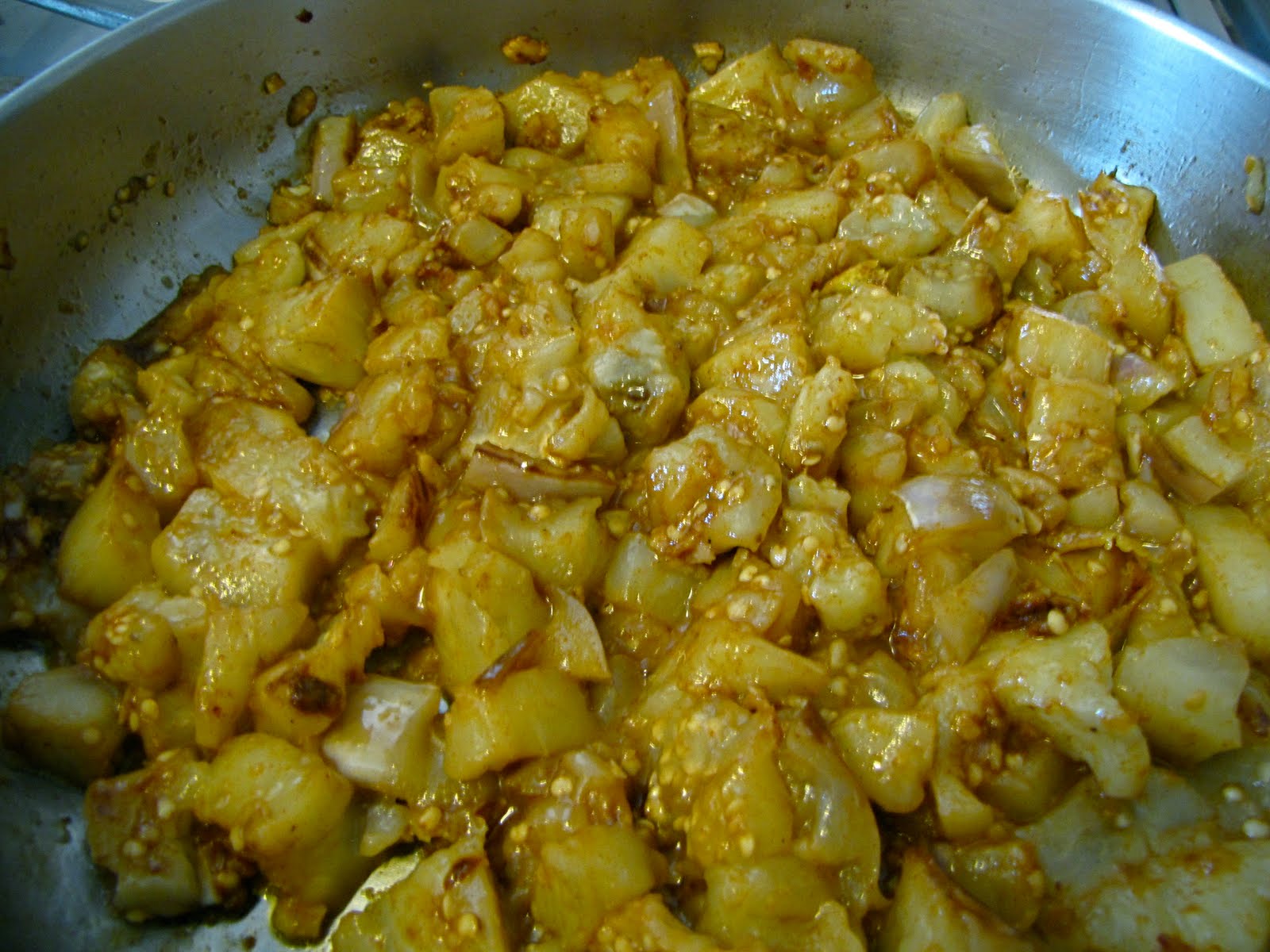
When all the slices are fried, roughly chop the cooked slices and return the eggplant to the pan. Add more oil if you need to, but wait to see if you really need it. Eggplants can absorb a lot of oil when cooking and then release it when almost done. Add the garlic spice paste to the pan and continue to cook for about 15 minutes stirring and breaking down the chunks of eggplant with a wooden spatula. Let the eggplant mixture cook until it gets a nice deep golden brown. Taste for seasoning.
Finish the salad with lots of chopped parsley and the juice from 1/2 a lemon.
Let the salad come to room temp before serving. The eggplant will be creamy with a deep rich flavor from the spices. This can be made a day in advance and stored in the fridge. Serve this salad outdoors as part of a picnic and it will feel like a trip to the oasis!

Amanda
Wow! That looks wonderful. I would love to try that on a slice of terrific, crusty bread. And I love that the dish is so simple. Now, this is a dish that I would pay attention to the spicy flavors when choosing a wine to go with it. The cayenne pepper will give heat - so be sure not to pick a wine too high in alcohol content. The high alcohol content in wines will exacerbate the heat of the pepper. A wine with a touch of sweetness, however, will be a great contrast to the heat and will complement it well. A German Riesling would make a tantalizing match to this beautiful dish. Seek out a "Kabinett" which tend to be off-dry, and light with crisp acidity.

For those of you unfamiliar with the German system of classifying wines, it can be extremely daunting. People tend to veer over to the German wine section, take a look, and coyly turn away. Don't let the enigma of the label deter you from experimenting - the wines are worth it. And once you understand their system better, you will be able to decipher any label.


Why people tend to avoid German wines. They are confused about what they're buying!

In a nutshell, Pradikatswein is the top level of the classification system. Most of the wines in this category are of high-quality. Within this level, wines can range from dry to very sweet, depending on the grapes level of ripeness, with Kabinett being the first designation. The sugar content of the grape juice helps determine into which designation the wine will fall. Spatlese is the next level up, and is typically fruitier and sweeter than the Kabinett. From there, the wines increase in sweetness into the categories Auslese, Beerenauslese, Eiswein, (yummy); and Trockenbeerenauslese, with each rung on the ladder being sweeter, with higher sugar content, then the last. For Deb's recipe, I would stick with either a Kabinett or a Spatlese. (Also, German wines are typically lower in alcohol content).


Today, many German producers are making their labels much simpler and user-friendly.

For wonderful Rieslings, look for the wines of Joh Jos Prum. The wines are simply marvelous. Weingut St. Urbans-Hof is another of my favorite German producers. Spectacular wines at affordable prices. The Ockfener Bockstein Riesling Kabinett is a terrific representation of the wines from the Mosel Saar Ruwer region (and would be exquisite next to Deb's dish). This particular wine can be found in the $15 price range.

If you are looking to enjoy a red with this dish, my first choice would be a fruity, new-world Pinot Noir. (New world meaning American, Australian, e.g. as opposed to old world like French). Again, avoid wines with lots of alcohol like Australian reds or big Cabernet Sauvignons.

Monday, August 31, 2009

Good things in small spaces

Deborah

A visit to Hook Mountain Growers
Dr. Pamela Yee and her husband Dr. Charlie Paolino have taken on a life project dear to their hearts. They have converted a portion of their sprawling Nyack, NY suburban backyard into a magnificent kitchen garden. It's more of a mini-farm with a wide range of vegetables and herbs thriving in terraced raised beds. Pam calls her project "homesteading". I call it amazing!
My recent visit to see what a small garden could yield was well rewarded with a perfect sunny day, an eyeful of beautiful bounty and an armload of freshly picked produce.


Butters the bull dog guards the tomato harvest

Pam and her husband devote many hours to the land and I envied the peace and tranquility of their natural back-to-the-land lifestyle so close to NY City. The abundance is impressive and not withstanding the devastation of the tomato blight the couple are able to sell their produce to friends and neighbors on the weekends.
I purchased several pounds of tomatillos for a salsa I planned to make for a large party I was catering in the Hamptons. I picked up a few more vegetables to bring home for my family (Pamela allowed me to choose the most gorgeous peppers right off the plant!) and came home with a grilled ratatouille in mind. The classic French vegetable stew is always an inspiration when the harvest comes in. Rather than slow cooking on the stove, I opted to grill the traditional mix of vegetables. After grilling they are roughly chopped and and then briefly simmered w/ garlic oil and fresh herbs. This can be made the day before and allowed to sit overnight to allow the flavors to blend. Pretty, simple and delicious. Thank you Hook Mountain Growers!

Grilled Ratatouille
The key to this recipe is to keep it rustic. Use the vegetables and herbs you have on hand. I like spicy so I always add some hot peppers. Amanda, the final dish is loaded with flavor and very robust, with a smoky undertone from the grilling. What would you suggest for a compatible wine?


Vegetables before grilling and after


1 eggplant sliced into 1 inch disks
1 onion sliced into quarters w/ root attached to keep pieces together
2 small bell peppers left whole
1 zucchini sliced on an angle into wedges
2 medium tomatoes cut in half
1 jalapeno pepper (optional)
Olive oil (about 6 tablespoons)
3 garlic cloves roughly chopped
small handful of fresh herbs roughly chopped (parsley, tarragon, oregano, basil in any combination)

Brush the vegetables w/ olive oil and grill over hot coals till tender, about 10-15 minutes. Remove charred skin from the peppers and roughly chop all the vegetables and set aside. Heat 3 tablespoons of olive oil in a sauce pan and add the garlic. Simmer garlic till it begins to turn golden, about 5 minutes. Add the chopped vegetables and the white wine and herbs and simmer for another 10 minutes till flavors combine and wine begins to evaporate. I aggressively mash down the larger pieces of vegetables with the end of a wooden spatula while the stew simmers to further "rusticate" the dish.

Remove from pan and refrigerate overnight to allow the flavors to blend (I can't wait that long and always eat some right away!). Can be served warm or cold.
serves 4

Amanda
Deb, this looks and sounds absolutely wonderful! Right away, I think of a red. Something with lots of earth but not too powerful as to overwhelm the vegetables. My first thought would be Cabernet Franc, originally from the Bordeaux and Loire Valley regions of France. While it is now grown successfully around the world, I would choose something from the Loire. Chinon is the red wine, made from Cabernet Franc, which comes from this specific area. The wine typically has beautiful aromatics, and has that hint of tobacco which should work well with the smoky flavors from the grill. One of the leading domaines in the area is Couly Dutheil, a favorite of mine. Their Chinon is deep and dark, with lots of complexity - definitely a "food wine". The rusticity of the wine would do wonders with that same quality of the dish.

With this recipe, my mind also wanders to thoughts of Malbec. Originally from the southeast of France, Argentina does wonders with this varietal as well. While the grape is used mostly for blending in France, with the exception of Cahors, it has achieved great success in Argentina due to the hotter climate. And great bargains abound. One of my favorite Argentine winemakers is Susana Balbo, who in my book, can do no wrong. This seems like a perfect combination for an impromptu get-together with friends!